See it. Solve it. Scale it.
Investigate a workforce or business concern. Build a financially grounded case for action. Understand where AI should change work to create business value.
Start with the decision you need to make. Each solution stands on its own, with one Workforce-to-Business Impact discipline connecting them.
Turn workforce investment into business impact.
Match the depth of the analysis to the size of the decision.
Is this issue real, what’s connected, and does it deserve action?
What you get: A qualified Finding Brief and a clearer direction for what to investigate next.
Start with First Signal Essentials to try the W2B Impact method.
Explore First Signal →What’s driving the issue, what’s the financial impact, and what should we fund?
What you get: A financially grounded recommendation that HR, Finance and Operations can evaluate together.
Explore Rapid Impact →Where could AI change work to create the greatest business value?
What you get: A view of AI workforce opportunities and actions with business, capacity, and skills impacts to evaluate.
Explore WorkShift →Test the drivers before you fund the fix.
The proposed intervention is an across-the-board pay increase to reduce turnover. The business question is whether it addresses the conditions behind the problem.
Test pay alongside manager effectiveness and other relevant conditions. Compare the evidence before selecting the intervention.
Connect the workforce conditions to operating performance and financial outcomes, with the assumptions and limitations visible.
Weigh the cost of the proposed response against a targeted intervention. Identify what deserves funding, further investigation or a pilot.
Illustrative financial example—modeled opportunity.
Different responsibilities. One common evidence base.
Expert methods, built into guided analysis.
Start with a workforce concern or a business result. Trace the connections through workforce conditions, operating outcomes and financial consequences. Test competing explanations and assess what the evidence supports.
Follow the evidence. Test the assumptions. Understand the financial consequences.
The method helps your team distinguish supported Findings from possible explanations, identify what remains uncertain and determine the next step.
Ruling out an unsupported explanation can be as valuable as identifying a promising one.
Read the W2B Impact Framework (PDF) →Take the First Signal tour →
What AI can do is only half the decision.
WorkShift evaluates where AI can augment, automate or reshape work—and what those changes could mean for workforce capacity, skills and business performance.
Its structured analysis identifies potential AI opportunities across roles and tasks. Business evidence helps determine which opportunities deserve priority.
See where to protect, augment, automate or redesign work—and where changing it could create the greatest value.
Explore WorkShift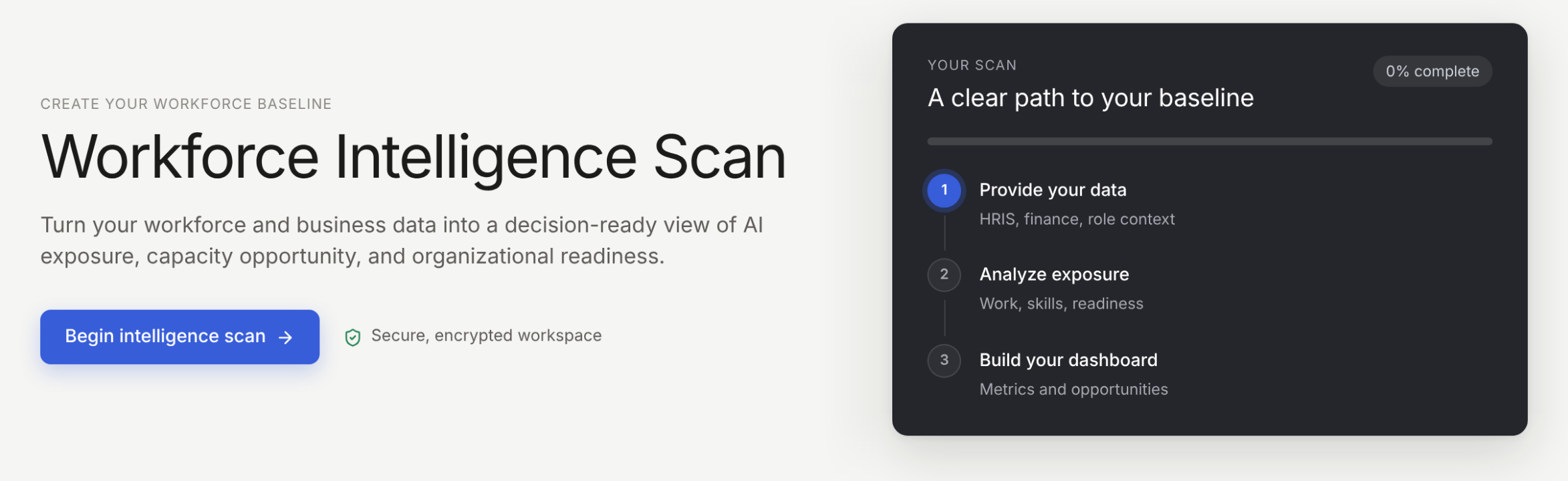
Start with a workforce, business or AI priority. Connect the findings to maximize business value.
Your reporting supplies the evidence. W2B Impact guides the analysis.
There’s no data integration and no new system to set up. W2B Impact tells your analysts what evidence to look for and where to find it, and they enter what they find in the reports HR, Finance and Operations already produce.
First Signal and Rapid Impact
For each question, the guided method points to the relevant measures, such as turnover, engagement, overtime, labor cost, service or output, and where they usually sit. Your analyst enters the figures. Nothing connects to your systems.
What you don’t need
No integration, no data warehouse project and no change to how you report today.
WorkShift
One anonymized roster file. The uploaded file is kept 30 days, and data in the app is kept 60 days after the subscription ends. It is processed by Anthropic under no-training terms.
Download the Data and Security Brief (PDF) →
Not sure where to begin? Bring us the workforce, business or AI challenge you’re facing.
We’ll show you how W2B Impact would approach it and help you get started.