The analysis is built in. Your team supplies the judgment.
W2B is a guided workforce-to-business analytical system. It gives your team a structured, repeatable method — with the rigor built in — to find the workforce conditions behind a business result, test them, and size what they’re worth.
Two ways in. One method.
Start from a business result or a workforce concern, or step back and review the strategy. Same rigor, different starting altitude.
Start with a specific issue. Trace the connection, test the evidence, size the consequence.
What is behind the overtime and margin pressure at our sites?
Why hasn’t revenue per employee moved since the AI rollout?
What is driving customer churn at certain locations?
Examine where the workforce is driving, constraining or failing to deliver performance across the business.
Which workforce conditions decide whether our AI investment pays off?
Where is workforce capacity constraining growth?
Which teams outperform, and what is different about them?
The AI investment is committed. The return depends on transforming your workforce.
AI transformation forces hard calls: which work stays, which changes, and what to do first. Those calls depend on conditions most companies can’t see together, like skills, manager support, capacity, and whether the work was actually redesigned.
W2B tests which workforce conditions are helping or blocking the return, traces them to operating results, and sizes what they are worth, so AI decisions rest on evidence.
Five phases, built in. So the Finding holds up.
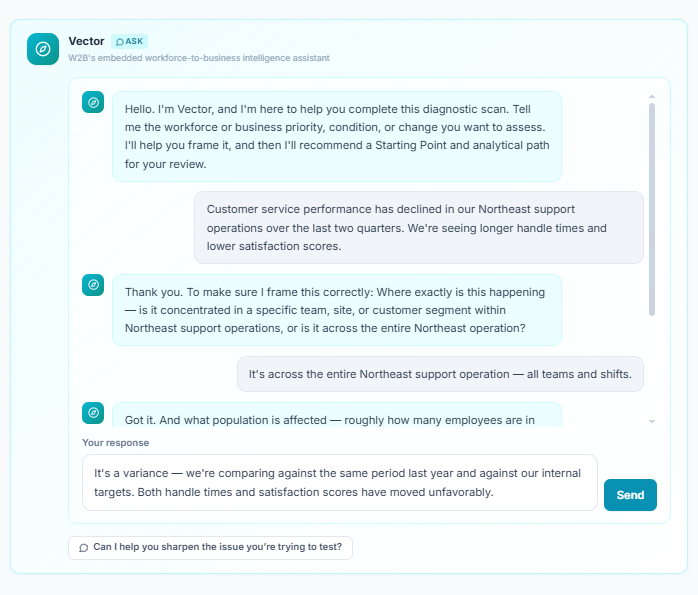
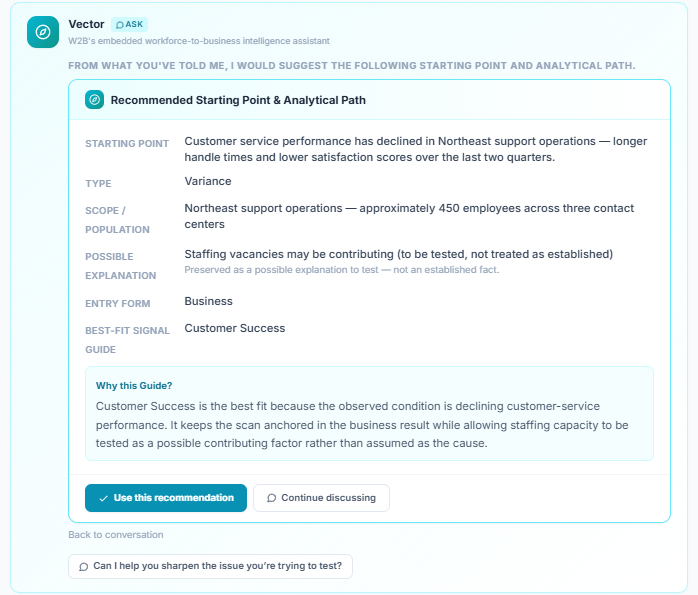
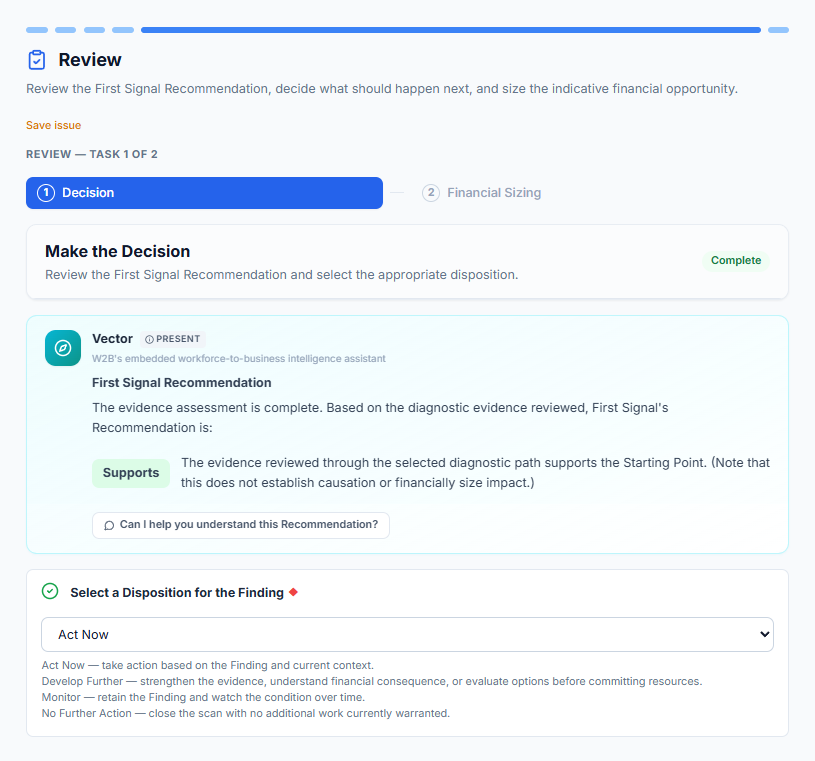
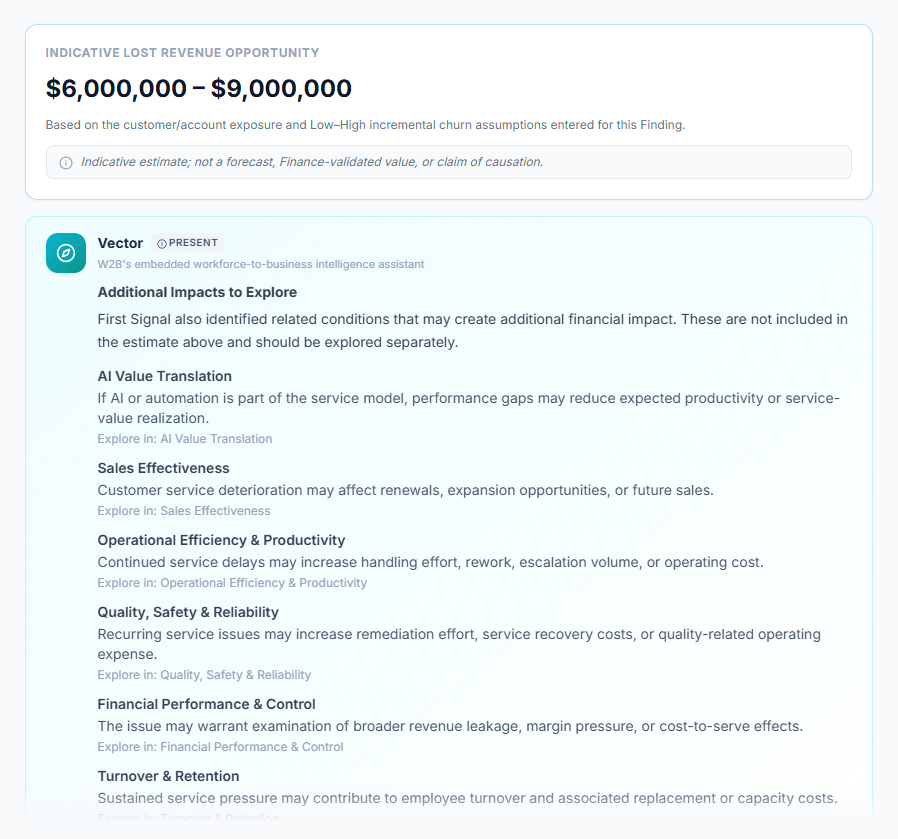
Every scan follows the same five phases, in about 1–2 hours. The structure is fixed, the expertise is built into each phase, and your team makes the judgment calls.
When the issue is material, go to a decision-grade Finding.
Structured 2–4 week sprints: about a week of focused work for a collaborative team of three, across HR, Finance and Operations. HR confirms the workforce conditions. Finance confirms the P&L connection and signs off the numbers.
↻ Learn. Every sprint adds confirmed baselines, tested hypotheses and measured outcomes, so the next one is faster and sharper. Explore Rapid Impact →
A CFO sees margin pressure from rising overtime. W2B traces it back through capacity, scheduling, manager effectiveness and workforce supply, and tests the evidence.
Illustrative.
A Finding leadership can act on.
Most analysis tells you what it found. A W2B Finding also tells you what it doesn’t support.
General AI starts from general knowledge. Vector starts from W2B.
In First Look, Signal Assist explains the reasoning behind each step and recommendation — without AI. Signal Assist shows you why. Vector helps you get there faster.
How companies handle this today
Most organizations use one of four approaches to connect the workforce to business results. Each has limits.
W2B is a different approach. The rigor of a consultant. The speed of an analyst with AI. A structured expert method that works from the data and systems you already have — and a capability your team keeps.
22 domains. Half start from the business question.
Eleven Guides begin with the workforce and trace forward to operating and financial consequence. Eleven begin with the business result (customer success, sales effectiveness, financial performance, AI value) and trace back to the workforce conditions behind it. Each has best-fit measures from the Metrics Hub.
Labor Spend Optimization
Turnover & Retention
Recruiting & Hiring
Leadership & Development
Workforce Planning
Compensation & Benefits
Training
Mobility & Career Development
HR Service Delivery
Financial Performance & Control
Quality, Safety & Reliability
Customer Success
Sales Effectiveness
Risk, Compliance & Resilience
Business Growth & Strategy
Financial Planning & Analysis
Product Planning & Innovation
Data Management & Analytics
Start with what the decision needs. Add depth as it matters.
Common questions
Why not just use ChatGPT or Copilot?
AI answers the question you ask. It doesn’t know which question to ask. Without a structured workforce-to-business method — Signal Guides, driver conditions, competing explanation logic, evidence assessment, consequence pathways — AI will give you a plausible answer fast. It may also give you the wrong answer, miss the actual driver, or build a convincing case for an intervention that doesn’t address the root cause. W2B makes sure the right questions are asked, the evidence is tested, and the Finding is defensible. Vector accelerates that process. It doesn’t replace it.
Is this directional or definitive?
First Signal Findings are directional — grounded in available evidence, tested against competing explanations, with explicit assumptions and limitations. They are rigorous enough to prioritize action and justify deeper analysis. They are not statistical proof of causation. When a Finding warrants greater certainty, Rapid Impact provides deeper driver analysis, cross-Finding synthesis, and more detailed financial sizing. The confidence framework is explicit at every stage: you always know how much certainty the evidence supports.
Who on our team runs it?
W2B is designed for cross-functional teams — HR, Finance, and Operations working together. No dedicated people analytics team is required. HR brings workforce signals and context. Finance brings cost structure and P&L knowledge. Operations brings frontline data and reality-checks the pathway. The method guides the analysis. Vector assists at the decision points where judgment matters most. Typical users: HR leaders, HRBPs, Finance partners, analysts, and Operations leaders.
Can W2B tell us whether our AI investment is paying off?
W2B tests which workforce conditions are helping or blocking the return (adoption and readiness, manager support, skills, capacity), traces them to operating results, and sizes the gap. It does not measure how well the AI tools themselves perform. It shows whether your organization is set up to get the value from them.
We already have HR and finance reporting. Why do we need this?
Reporting shows what is happening. W2B determines what is driving it, which workforce conditions matter and how much is at stake. It doesn’t replace your reporting — it makes it more valuable.
Do we need new systems or integrations?
No. W2B works from the reports, metrics and systems you already have. No data warehouse, no integration project.
How is our data handled?
W2B doesn’t connect to your systems or store employee-level records. Your team enters a few summary figures from reports you already have.
See W2B work on a real business question.
Book a demo on your own issue, or try the method with First Look.